-
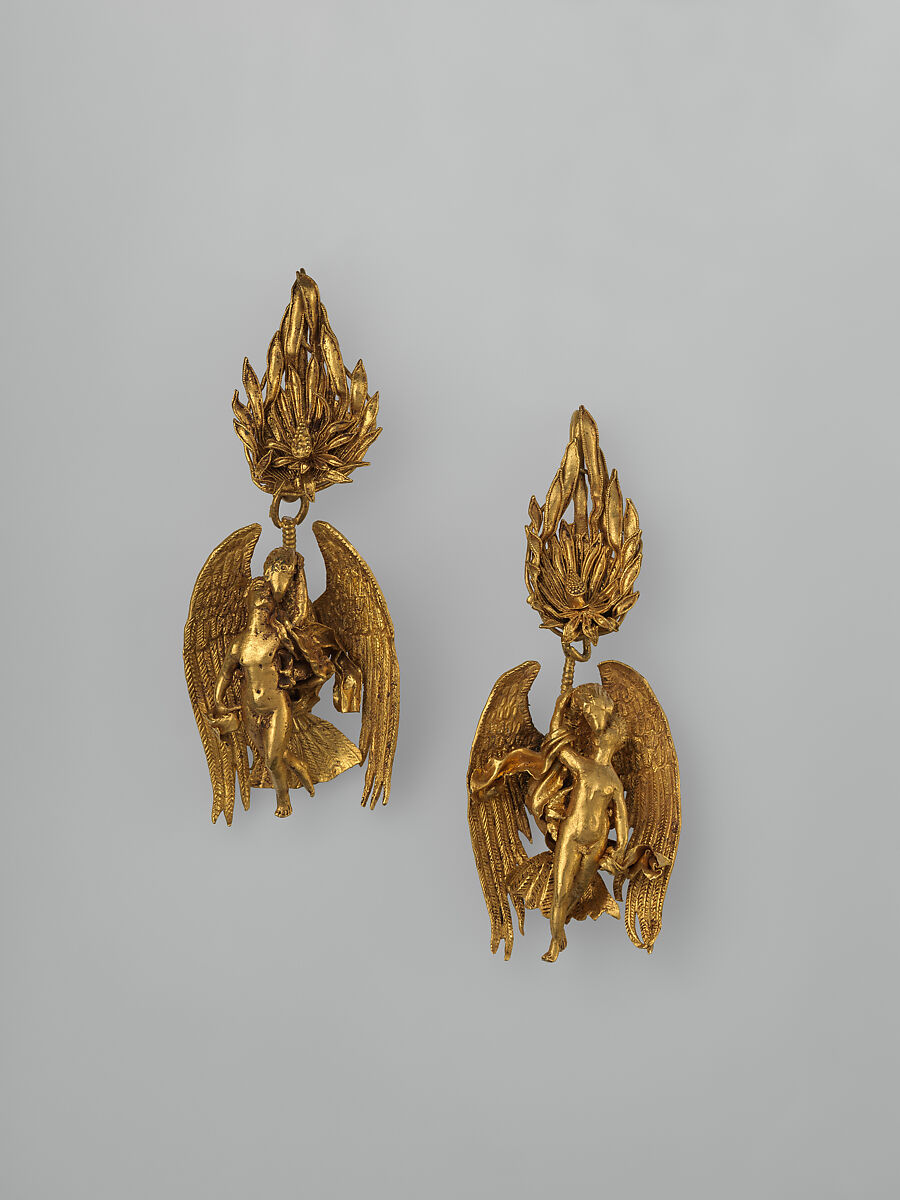
Title: Pair of gold earrings with Ganymede and the eagle
-
Period: Classical
-
Date: ca. 330–300 BCE
-
Culture: Greek
-
Medium: Gold
-
Dimensions: total H. 2 3/8 in. (6 cm); H. of rosette 1 in. (2.5 cm); H. of Ganymede group 1 3/16 in. (3 cm)
- Collection:MET
These superb earrings consist of a large honeysuckle palmette below which hangs a finely worked three-dimensional figure of the Trojan prince Ganymede in the clutches of Zeus, who has assumed the guise of an eagle. Coveted by Zeus for his beauty, Ganymede was carried off to Mount Olympos to be a cup-bearer for the gods. The pendants are sculptural masterpieces in miniature, which no doubt reflect in their basic conception a famous large-scale bronze group of the same subject, made by Leochares in the first half of the fourth century B.C. The airborne theme is ingeniously adapted here to an object that hangs freely in space.
**
The Macedonians of northern Greece often buried their dead with rich grave goods, including finely crafted gold jewelry. This remarkable pair of earrings comes from such a burial context and reflects the extraordinary refinement achieved in Greek goldwork in the fourth century B.C. In this pair, each earring features a solid-cast nude boy in the clutches of a majestic eagle. The boy is the young Trojan prince Ganymede, whom Zeus carried away up to Olympus to be his cup-bearer. The eagle is Zeus’ bird, or Zeus himself, tenderly holding Ganymede in his talons.
The Greek goldsmith treated the earrings as sculpture in miniature and lavished them with a wealth of fine detail. Look at the eagle’s feathers and the delicate wisp of drapery fluttering in the air. The toes of Ganymede’s front foot are flexed; perhaps he is just touching down on Mount Olympus, the home of the gods.
This motif works beautifully for a pair of drop earrings, dangling over the wearer's shoulders. But the goldsmith probably adapted the composition from a piece of large-scale sculpture. The ancient writer Pliny described one such work in these words: “The eagle senses what a prize he is ravishing in Ganymede, and to whom he is carrying him.”


