

Granulation: The Most Refined Language of Ancient Jewelry
Apr 26, 2026
Even to non-specialists, granulation is difficult to miss. Spend a little time with ancient jewelry—especially its finest surviving gold works—and your eye will eventually settle on surfaces formed not by engraving or casting, but by countless minute spheres arranged with striking precision in linear and figurative designs. Across many of the most celebrated objects of the ancient world, this technique appears with quiet consistency.
 Figure 1. Gold sanguisuga-type fibula (safety pin) with meandering and zig-zag patterns in granulation, seventh century BCE. Metropolitan Museum of Art.
Granulation at its finest invites instant admiration. These clustered grains of gold do not simply decorate a surface—they transform it into a vibrant textural maze, introducing rhythm, density, and light. What appears as simple raised features reveals itself upon closer inspection as remarkably intricate and puzzling to explain. How could such complexity be accomplished on such a tiny scale?
A Closer Look
Granulation changes the nature of the surface. Instead of carving into metal, it builds it outward—through accumulation. This requires precision at every stage. Granules must be produced in large numbers, often on an extremely small scale, yet remain consistent in size and form. This could be done by clipping thin wires of gold and heating the clippings with charcoal. When the clippings are heated with the charcoal, they form into spheres which, once cooled, can be arranged on the work surface with adhesive material. The metalworker must carefully arrange and fix them to the surface without compromising the form and integrity of the design. When the design is heated again, the granules adhere to their substratum.
 Figure 2. Detail of an Etruscan gold fibula, 7th century BCE (possibly from Vetulonia). The surface granulation is clustered to create dense animal and geometric patterns.
There are several types of techniques used to apply granulation to create particular designs (Wolter 1981). Linear granulation refers to metal grains that are arranged in lines along a smooth surface. Massed or field granulation is when the grains are packed in sheets and joined to the surface with or without surrounding elements, such as embossed decorations. Cluster granulation describes the technique of using the grains to create three-dimensional structures, as seen on the fibula in Figure 2. Cluster granulation is sometimes used on the outer edges of items, to form a raised frame or lace-like border, as seen in the pendants on the necklace shown in Figure 5.
As a technical process, granulation signals detailed and precise control over material, proportion, and design execution. It reflects countless hours of training and discipline as much as the intention of the design. Ancient jewelers worked with select alloys, crucibles, heat, and precision to construct one the most intricate surfaces in the history of jewelry production.
Origins and Spread
Granulation is among the oldest techniques in metalwork. Its earliest documented appearances come from ancient Mesopotamia as early as the third millennium BCE (Wolter 1983). From there, it spread widely across Eurasia through trade networks, migration, and the movement of skilled artisans.
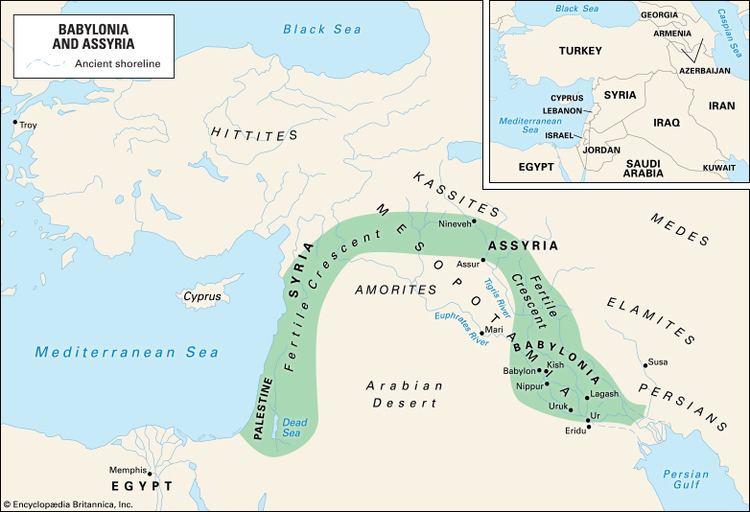 Figure 3. Map of the Fertile Crescent during the Bronze Age (c. 3,000-1,200 BCE)
The map in Figure 3 shows ancient Mesopotamia and the cities in what is known as the Fertile Crescent: the land that extends around the Tigris and Euphrates rivers down through the Levant. This region has often been described as the cradle of early civilization. As people from the Fertile Crescent migrated over time to western areas of the Mediterranean, they spread their religions, language, and cultural products, including jewelry and jewelry-making techniques.
Over time, granulation spread from ancient Mesopotamia to Egypt, the Aegean, Greece, and Italy before extending across the eastern Mediterranean and beyond. It entered regions as distant as India, Iran, China, and Korea (Figure 6). Its history is therefore not confined to a single culture, but shaped by continuous movement and adaptation that began in the ancient Middle East.
Granulation in Etruscan Jewelry
Many remarkable specimens of granulation come from Etruscan jewelry of the seventh and sixth centuries BCE. The Etruscans did not invent the technique, but they brought it to an exceptional level of refinement, transforming it into one of the defining visual languages of their craftsmanship.
 Figure 4. Map of ancient Etruria in central Italy, with arrows showing the extent of their connectivity across Europe in antiquity.
In some Etruscan pieces, individual granules can measure as little as a fraction of a millimeter in diameter, yet remain precisely formed and consistently arranged across the surface. This is the product of expert measuring and heating of metal particles, which, when done correctly, yielded spherical grains of uniform size (Formigli & Nestler 2010).
 Figure 5. Set of jewelry, Etruscan, early 5th century BCE. The Metropolitan Museum of Art.
An exceptionally rich jewelry assemblage – including a necklace, disk earrings, fibulae, rings, and a dress pin – was discovered from a tomb in Vulci during nineteenth century excavations. The earrings and necklace were made with granulation techniques, in both cases to emphasize the circular and ovular forms of each piece. The assemblage illustrates how granulation rarely appears in isolation in Etruscan jewelry. It is often combined with filigree, chasing, and repoussé, creating complex surfaces in low relief.
Continuity
Granulation is often described, particularly in European accounts, as a “lost” technique later rediscovered. This view reflects a break within certain traditions, but not the full history of the craft. Evidence from regions such as India, Iran, and China suggests that related practices continued or re-emerged over time. Granulation in an ear ornament from India (Figure 6), for example, reflects the continued presence of related techniques beyond the Mediterranean world.
 Figure 6. One from a pair of ear ornaments (Prakaravapra Kundala), India, Andhra Pradesh, ca. 1st century BCE–1st century CE. Metropolitan Museum of Art.
The old sentiment of a “lost” technique, then, may have only been the case for the Western world, which would not see extensive use of granulation again until the Castellani family revived the ancient methods in nineteenth century (Soros & Walker 2004).
Future Investigation
Granulation remains a subject of ongoing study because the objects are preserved, but the exact processes behind ancient examples are not fully documented. Surviving works provide strong material evidence, yet the methods used to produce and attach the granules are still interpreted in different ways. No single explanation accounts for all historical examples.
The questions are consistent: how did ancient metal workers pass down the knowledge to produce such massive quantities of granules? What experimental processes were employed to find the best methods of fusing granules to their substrates? In short, what do the traces left on surviving objects reveal, both from a technical standpoint and a cultural one? Different answers have been proposed, and no single model explains every case – a testament to the diverse and localized skills across the ancient world when it came to this technique.
Ultimately, the development and spread of granulation marks the broadening of the technical vocabulary for visual expression in metal craftsmanship, one that diverse peoples absorbed and reinterpreted on their own cultural terms over time. Long before it became associated with any apex of technical achievement, it had already become one of the most mobile and enduring languages of ancient ornament, and continues to exist as such today.
Figures
1. Courtesy of the Metropolitan Museum of Art, New York. Original Available at: https://www.metmuseum.org/art/collection/search/253339.
2. Fertile Crescent. From Encyclopedia Britannica. Accessed April 25, 2026. https://www.britannica.com/place/Fertile-Crescent
3. Courtesy of Rhode Island School of Design Museum. https://risdmuseum.org/art-design/collection/pin-fibula-30051
4. Map from Wikimedia Commons (Author: 0 Noctis 0). Shareable under CC BY-SA 4.0 license.
5. Courtesy of the Metropolitan Museum of Art, New York. Original Available at: https://www.metmuseum.org/art/collection/search/256976
6. Courtesy of the Metropolitan Museum of Art, New York. Original Available at: https://www.metmuseum.org/art/collection/search/39676
References
Wolters, Jochem. Die Granulation: Geschichte und Technik einer alten Goldschmiedekunst. Munich: Callwey, 1983.
Wolters, Jochem, “The Ancient Craft of Granulation: A Re-Assessment of Established Concepts,” Gold Bulletin, Vol. 14, no. 3 (1981). pp.119-129.
Nestler, Gerhard, and Edilberto Formigli. Etruscan Granulation: An Ancient Art of Goldsmithing. Brunswick, ME: Brynmorgen Press, 2010.
Soros, Susan Weber and Walker, Stephanie (Eds.). Castellani and Italian Archaeological Jewelry. Yale University Press, 2004.
Further Reading & Resources
Caines, Jeanette K. “Granulation Demystified.” In Proceedings of the Santa Fe Symposium on Jewelry Manufacturing Technology, 2016.
Carroll, Diane Lee. “A Classification for Granulation in Ancient Metalwork.” American Journal of Archaeology 78, no. 1 (1974): 33–39.
Carroll, Diane Lee. “On Granulation in Ancient Metalwork.” American Journal of Archaeology 87, no. 4 (1983): 551–554.
Huycke, David. The Metamorphic Ornament: Re-thinking Granulation. Hasselt: Hasselt University, 2010.
Huycke, David. “Decorative and Structural Granulation in Larger Silver Artefacts.” Santa Fe Symposium Proceedings, 2022.
Lilyquist, Christine. “Granulation and Glass: Chronological and Stylistic Investigations at Selected Sites, ca. 2500–1400 BCE.” Bulletin of the American Schools of Oriental Research 290 (1993): 29–94.
Rosenberg, Marc. Geschichte der Goldschmiedekunst auf technischer Grundlage, Vol. 3. Frankfurt: Verlag von Heinrich Keller, 1918.
The Metropolitan Museum of Art. “Collection Database: Ancient Jewelry.”
https://www.metmuseum.org/art/collection
The British Museum. “Collection Online: Gold and Granulation.”
https://www.britishmuseum.org/collection
The Metropolitan Museum of New York. “Gold Jewelry Techniques: Granulation.”https://youtu.be/zCikTT1zjfY?si=eV0jF6ELxUahS_eL

